

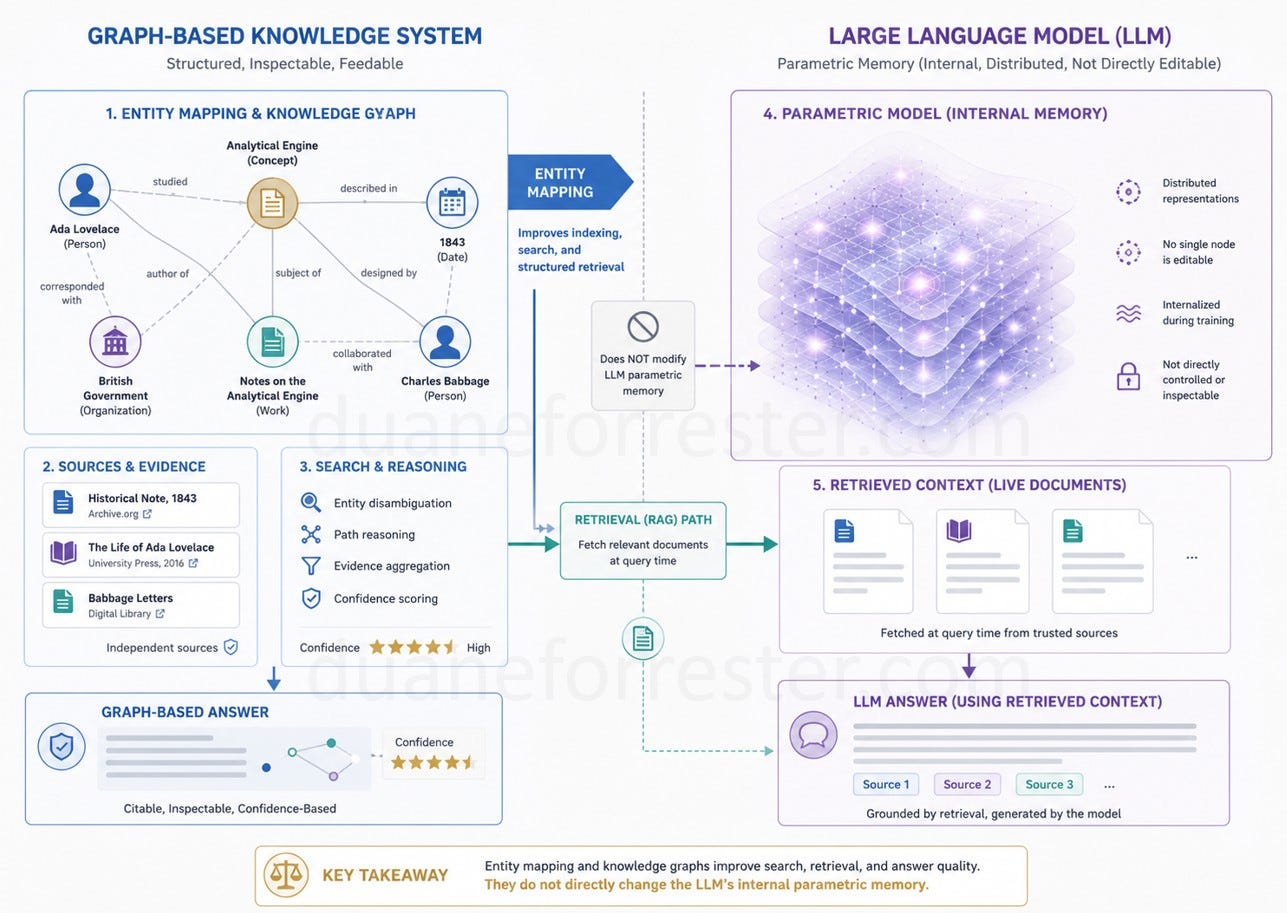
If entity mapping feels familiar, that is because you already ran this play. It is the knowledge graph conversation you were having in 2021, wearing a 2026 outfit. The vocabulary migrated almost intact: entities not strings, disambiguation, sameAs, relationships between nodes, feed the structure and the machine understands you. Pull a client deck from four years ago, swap “Knowledge Graph” for “the AI,” and most of the slides would survive the move. That is why the term is spreading, and it is also the reason to slow down before you buy it. The compressed version, in case you read no further: entity mapping does real work on Google, where there is an actual graph to feed, and almost no work on the language model itself, where there is no graph to feed and never was. Those are two different systems with two different rules, and the industry sells them to you as one tactic. Keeping them apart is important for the systems and LLMs.
On Google, there is some value.
The Knowledge Graph is a real, curated object (not to be confused with, say, your knowledge graph, which is your own, maintained graph of entities and relationships). Google launched it in 2012 under the banner things not strings, and it has spent the years since becoming the layer that decides who and what a query is about before a single result loads. You feed it, but only indirectly, through structured data, consistent third-party corroboration, and maybe a clean Wikidata entry that independent sources agree with. You do not fill out a form and submit yourself. You assemble enough agreement across the open web that Google’s systems conclude you are a distinct, real thing worth having a node for. The reason self-declaration alone does not do it is that the graph is a confidence machine, not a submission box. Your schema states what you claim to be; the node gets built and trusted when enough independent, credible sources say the same thing back to Google. That is why a well-referenced Wikidata item and a handful of authoritative mentions move more weight than a flawlessly marked-up page that only ever talks about itself, and it is why Google has spent recent years tightening the graph toward entities it can corroborate with confidence rather than ones that merely assert themselves. And because Google’s AI answers resolve entities against that same graph before they generate, the work now reaches past the ten blue links and into the AI surfaces too. On Google, entity mapping has a target, and the target has a mailing address. This is the part the support crowd gets right, but there is more.
Then the target system changes, and nobody announces it.
The conversation you had in 2021 assumed a discrete, inspectable, feedable object. A node you could pull up in a panel and correct when it was wrong. You could see your own entity, file a fix, and watch it change, and the whole practice grew up around a surface you could actually observe. Entity mapping keeps every word of that tactic and quietly repoints it at a system that has none of those properties. That repointing is the sleight of hand, and it works precisely because the words did not change. One assumption crosses the border undeclared: that the thing on the other side can be fed at all.
A language model has no node for you to feed.
Start with the term, because the whole confusion lives in it. Parametric memory is the knowledge a model carries baked into its weights, learned once during training, and distinct from what it looks up live when it answers you. On the parametric side there is no record of your brand to open and edit. No row, no node, no panel to correct. There is a diffuse statistical pattern smeared across billions of parameters, and it arrived there because the model read the corpus at scale, not because it read your markup. Interpretability researchers state it without hedging: factual knowledge in these models is parametric and emergent, with no single parameter holding any given fact and recall arising instead from distributed activation across the network. The mechanism deserves to be stated precisely, because the imprecision is where the tactic hides. During training the model sees your brand across millions of contexts and adjusts its weights to encode the statistical shape of how you are described: which entities you appear beside, which categories you fall into, which claims recur around you. Nothing in that process parses a schema block or honors a sameAs link. It reads language, at volume, and what survives is consensus, not code. Your page is one context among billions, and unless it is echoed and repeated elsewhere, its structured declarations weigh almost nothing against the mass of everything else the model ingested. You can add sameAs links until the whole page turns blue, and you will not have moved that pattern one inch, because the pattern never learned from your page. It learned from how often, how consistently, and how credibly the rest of the web talks about you. The uncomfortable consequence is that the highest-leverage entity work for the parametric side barely touches your website. It is getting cited in the places the model already trusts, earning mentions you do not control, and being described the same way by people who are not you. That work is slower, harder, and far more durable than a schema audit, which is exactly why the tidy on-site version outsells it.
It gets worse for the tactic. The model’s own map is not a map.
Grant me, for the sake of argument, that you could somehow reach the parametric side and write to it. You still could not mirror your diagram onto it, because the thing you would be mirroring is not shaped like a diagram. It pays here to remember what entity mapping actually is underneath. Every structured-data statement you make is a triple: a subject, a predicate, and an object. Your brand, sells, this product. This author, wrote, that article. That triple is the atomic unit of the semantic web, and it is the unit your entire entity practice exists to produce. It is also the unit the language model does not store. When researchers trace where this knowledge physically sits, they find that entity knowledge and relational knowledge live in different parts of the model and do not map onto each other. Change the entity in a fact and change the relationship in that same fact, and the model does not respond equivalently, even though your triple treats them as two interchangeable slots. So the clean subject-predicate-object structure your schema encodes, the very structure Google’s graph was built to consume, has no faithful counterpart inside the model at all. The nodes-and-edges picture entity mapping draws is a human convenience, useful for planning and useless as a description of the model’s internals. There is no tidy graph in there waiting for you to align to, which makes the deliverable a map of a territory that was never organized as a map. That is not a tuning problem you fix with better markup. It is a category mismatch, and no amount of schema closes it. Practically, it means you should stop grading your parametric work by how complete your entity markup looks, because the tidiness of the map tells you nothing about whether the model holds the territory.
Picture a mid-market vendor that has done everything the playbook asks. Complete Organization schema, sameAs pointing at every profile, a clean internal entity graph across the whole site. Ask ChatGPT about its category with search enabled and the vendor turns up, because the fetch found those well-structured pages and lifted from them cleanly. Ask the identical question with search switched off and the vendor is simply absent, because the model’s training never saw enough of the world describe it to encode it at all. Same company, same markup, same platform, opposite outcomes, and the only thing that changed was whether the system was allowed to go read the page. Google’s own surfaces sit in a third position, resolving against the graph the vendor has been feeding all along, which is why that side of the work keeps looking like it is winning.
Here is the part that translates.
Do not let any of this collapse into “nothing-matters”, because that’s an over-reaction. AI search is not purely parametric, and retrieval is doing enormous work. It helps to separate the surfaces, since they behave differently. When a model answers from memory with no search, you are hitting the parametric side, and nothing on your page reaches it. When Perplexity, Google’s AI answers, or a model in search mode fetch live pages before responding, you are hitting the retrieval side, where clean structure and clear entity signals genuinely help you get pulled and quoted. Most real answers now blend the two, using parametric knowledge to frame the question and retrieval to fill in the specifics, and that blend is exactly why the tactic feels like it works: it moves the retrieval half, visibly, while doing nothing to the parametric half you cannot watch. Helping a retriever find you and parse you is not the same as the model having learned you. One is a door you can open this quarter with disambiguation and structure. The other is a standing in the corpus that took years of being talked about to build and will take years to shift. Entity mapping reliably buys you the first and gets quietly sold to you as the second. Structured content earns you the fetch and a clean extraction; consistent corroboration across the wider web earns you the standing underneath it. Treating those as one item is the mistake.
This raises the obvious question of how you would ever know which system is actually moving. You cannot open the parametric side and inspect it, which is precisely what lets the promise go unchallenged. The only honest answer is to stop trusting the tactic’s story and watch the outputs directly: track whether you show up when the model answers from memory against when it answers from a live fetch, on the same questions, over time. If your presence climbs only on the retrieval-driven answers while the memory-only answers stay flat, you are watching the split happen in real time, and you are watching entity mapping do exactly half of what it was sold to do. Measurement is the tie-breaker the sales pitch cannot survive, which is the whole reason to insist on it.
The conflation is the product.
You will see it written that your entity data now trains ChatGPT and Claude. It does not. Those models are not trained on Google’s proprietary graph, and the only reason the claim passes at a glance is that Gemini can use Google’s own graph, which lets a Google-specific truth borrow a universal costume. A second tell is subtler and more common. A vendor shows you that pages with rich schema get cited more often and calls it proof of causation. But that correlation is exactly what you would expect for an entirely different reason: the pages built carefully enough to carry complete markup tend to be the same pages that are well-sourced, well-linked, and widely referenced, which is what actually earns the citation. The schema rode along. It did not drive. Schema stays what it has always been, infrastructure that helps machines disambiguate you rather than a lever that pulls a citation, and anyone reporting a correlation between marked-up pages and citations is watching outputs, not reading a mechanism. So carry one question into every pitch you hear. Ask the person selling entity mapping to name the mechanism by which your on-site graph changes what the model learned during training. If the answer is that the schema helps the AI understand, you have been handed an observation dressed as a mechanism, and the price tag belongs to a different product. The literacy that separates the practitioners who will win from the ones running last year’s play is this: know which system you are actually feeding, and refuse to pay graph prices for parametric promises.
If you are running entity work right now and watching it move your Google presence while the LLM’s own answers stay put, that gap is the tell, and I would like to hear how it is showing up for you. Leave a comment below.
Final thought: I have an opening in my consulting roster starting mid-August. If you want help working through any of this, get in touch.


